
MICHR Translational Pilot Awardees Work to Address Common Research Roadblocks
The Michigan Institute of Clinical & Health Research (MICHR)’s Clinical and Translational Science Pilot Award supports innovative research projects in clinical & translational science (CTS). CTS is a field of investigation focused on understanding and removing barriers that slow translational research so that new treatments and other health solutions reach people faster. Projects typically propose addressing a common cause of inefficiency or failure in research projects at any stage of translation, with the goal of producing foundational knowledge that will ultimately improve health.
We are pleased to announce that the following proposals have been funded in the fourth round:

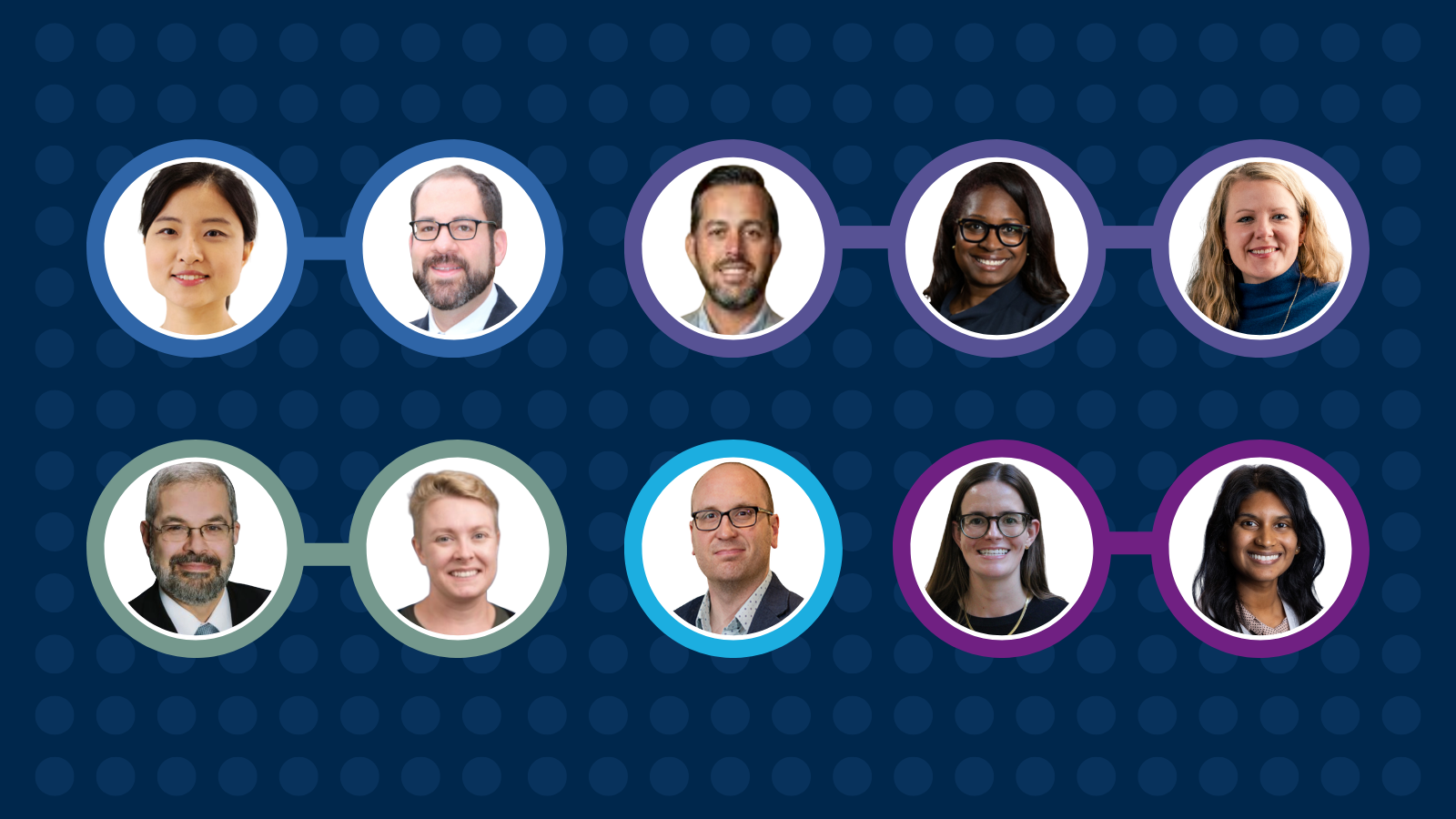
Top L to R: Fan Bu, PhD; Andrew Admon, MD; Paul Fleming, BS, MPH, PhD; Melissa Creary, BA, MPH, PhD; Lindsey Thatcher, MPH
Bottom L to R: Ed Hurvitz, MD; Alexandra Vinson, PhD; John Rice, PhD; Julia Kramer, PhD, MPH; Thiyagarajan, MD, MPH
The Digital Clan: Robust, Transparent Digital Twins for Personalized Treatment Evaluation
Investigators: Fan Bu, PhD, Assistant Professor, Public Health & Andrew Admon, MD, Assistant Professor, Internal Medicine
A major roadblock in translational medicine is delivering personalized healthcare for individual patients based on predictions of clinical outcomes under alternative treatment plans. Recently emerging digital twin technologies provide a promising solution by digitally emulating individual patient trajectories and comparing treatment options through what-if scenario simulations. However, many digital twin methods rely on deterministic simulators, which fail to account for uncertainty and tend to be black-box models that are difficult to interpret. This has hindered our ability to fully capitalize on real-world data for personalized healthcare. To fill this gap, we propose to develop a “digital clan” method that generates a credible set of probable patient trajectories under different treatment plans, which naturally provide uncertainty quantification. The digital clan is an ensemble of candidate digital twins, such as computerized models trained on observational data and historical patients with matching characteristics to target patients. This combination of simulated digital replicas and real-world patient trajectories balances accuracy and interpretability, following principles of ensemble learning. In this proof-of-concept project, we will develop a prototype digital clan framework and test it on cohort data obtained among patients hospitalized with acute respiratory distress syndrome (ARDS), pneumonia, and sepsis. We anticipate generating promising results that show improved accuracy, robustness, and reliability of the digital clan methods compared to conventional digital twin approaches. We will disseminate our work through open-source software and publications in leading academic journals and conferences. This project will be a first step towards general-purpose, trustworthy digital clan frameworks for practical clinical use.
Understanding the Factors that Influence Adoption of Research Evidence in Service Delivery Organizations
Investigators: Paul Fleming, BS, MPH, PhD, Associate Professor, Health Behavior Health Equity, Melissa Creary, BA, MPH, PhD, Associate Professor, Health Management and Policy, & Lindsey Thatcher, MPH, Managing Director, The Collaborative for Transformative Public Health
This project addresses a major translational science challenge: the slow and inconsistent adoption of evidence-informed (EI) research findings and interventions in service delivery organizations such as community clinics, nonprofits, local health departments, and other agencies outside of traditional medical care. These organizations are essential to the translational ecosystem, yet many do not see research as relevant to their work or the communities they serve. As a result, research is often underutilized, leading to years-long delays in dissemination and implementation that reduce efficiency and impact across the field. To address this challenge, this project will engage public health and social service organizations across Michigan using a mixed-methods approach, including surveys and semi-structured interviews. The study will identify contextual factors, barriers, and facilitators that influence how organizations access and apply relevant research, while also capturing opportunities and challenges that shape adoption of EI interventions. Findings will be synthesized into recommendations and a data collection instrument designed for broad use beyond Michigan, providing a foundation for future intervention development. By targeting organizational and contextual factors rather than specific disease outcomes, this work will generate strategies to accelerate uptake of EI interventions across a wide range of health domains, from infectious disease to maternal and child health to environmental health. Because Michigan encompasses diverse organizational types, populations, and political contexts, the resulting solutions will be highly generalizable to public health and service delivery systems in other regions.
Infrastructure for Collaboration: Assessing Barriers and Facilitators and Developing Recommendations to Promote Collaboration
Investigators: Ed Hurvitz, MD, Professor, Learning Health Sciences & Alexandra Vinson, PhD, Assistant Professor, Learning Health Sciences
The Learning Health System (LHS) model aims to accelerate clinical translational science (CTS) by moving new ideas into practice more efficiently. An LHS begins with forming a Learning Community, bringing together clinicians, researchers, patients, and others who share a common interest in addressing a specific problem. This group identifies the information needed to understand the issue and develops ways to collect relevant data during clinical care. Once the information is collected, members collaboratively analyze it and implement changes in practice based on their findings. However, most hospitals and clinics are not set up to support this type of collaborative work, which makes forming and sustaining an LHS challenging. Even though health systems often have ongoing data collection and analytic expertise, the lack of a formal collaborative framework like a Learning Community limits how effectively these resources can be used. In this study, we will conduct qualitative interviews with individuals involved in LHS efforts to gain a deep understanding of what helps or hinders collaboration in clinical environments. Insights gained from commonly expressed themes and experiences will inform the development of practical recommendations for supporting Learning Communities and fostering similar research collaborations. To further refine these recommendations, the Nominal Group Technique will be used to bring participants together to prioritize suggestions according to their likely impact, the effort required, and chances of success. Ultimately, disseminating these prioritized recommendations will help encourage the growth of Learning Communities and promote broader research collaboration within health systems.
Accurate Inference from Clustered Time-to-Event Data: Improving Trial Efficiency and Accelerating Promising Interventions
Investigator: John Rice, PhD, Assistant Research Professor, Public Health
Many clinical trials analyze data that are clustered: a patient may have several tumors, or clinics may care for groups of patients. Standard statistical tools often ignore these links, treating outcomes as if they were independent. That leads to misleading estimates of uncertainty, making weak effects look convincing or hiding true ones. The problem is especially serious for survival measures that matter to patients and clinicians, such as the median time to progression or the proportion surviving to a milestone. This project will develop and test new methods called Empirical Likelihood Variance Estimators (ELVEs). ELVEs calculate uncertainty without fragile assumptions, producing margins of error that better reflect the data. They work for a range of survival measures, from proportions event-free at fixed times to key milestones like the median. We will evaluate ELVEs under realistic trial conditions, including settings where participants leave early or outcomes are uneven. Applications will include oncology studies with multiple tumors per patient and HPV vaccine trials clustered by clinic. To support adoption, we will release open-source R software and plain-language guidance for research teams. By improving accuracy and trust in results, ELVEs will help trials make clearer decisions and speed the development of effective interventions.
Bridging the Gap Between Front-End Design and Back-End Translation: the Development of Mid-Design Evaluation Guidance for Medical Device Design
Investigators: Julia Kramer, PhD, MPH, Assistant Professor, Mechanical Engineering & Dhanu Thiyagarajan, MD, MPH, Assistant Professor, Obstetrics and Gynecology
Our world faces critical health challenges requiring medical device innovation. Many innovations do not cross the “valley of death”—the gap between a device’s front-end design and its successful back-end translation into real-world implementation, because there is little guidance for the critical “mid-design” evaluation phase. In this proposal, we aim to improve the translational potential of medical devices by refining and evaluating mid-design evaluation guidance to support multidisciplinary teams to collaboratively design medical devices with implementation in mind. We have already developed a preliminary framework for mid-design evaluation, which includes measures and guidance drawn from engineering, public health, medical education, and implementation science literature to assess device feasibility, acceptability, appropriateness, and expected adoption as part of the device design process. In this grant, we aim to: (1) refine our preliminary framework through a Delphi panel of engineering, public health, medical education, and implementation science experts; (2) apply the refined framework with student teams to assess its effectiveness in informing translation-ready medical device designs; and (3) experimentally evaluate the translational potential of medical device designs developed with and without the framework by surveying clinicians and patients. Our proposed activities will result in a holistic framework to guide the mid-design evaluation of medical devices, which can contribute to improved design processes of multidisciplinary medical device design teams, thus aiming to enhance access to medical devices around the world and improve health outcomes that result from the use of these medical devices.